

I’ve been thinking a lot about what it means to be human in the age of AI. Not whether AI is good or bad, and not whether we should embrace it or reject it. I think those questions are becoming increasingly inadequate for the moment we’re living through.
The question I’m much more interested in is this: What kind of humans do we choose to become while using it?
Because AI is here. It is powerful. It is imperfect. It can create extraordinary things, and it can also cause real harm. I don’t believe our responsibility ends with deciding whether we personally approve of it. I believe our responsibility is to learn how to steward it.
AI does not need to be human to expand what humans can do
One of the criticisms I often hear about generative AI is that it has no lived experience. It doesn’t know what grief feels like. It has never fallen in love, raised a child, built a business, lost someone, had its heart broken, stood in front of a blank canvas or wondered what the hell it is doing with its life. All true. But why does it need to?
A piano has never experienced heartbreak either. A camera has never stood before a sunset and felt awe. A paintbrush has no imagination. A library has no wisdom of its own. The instrument does not need to possess the human quality it helps us express. The human brings that.
We bring the lived experience, context, intention, values, judgment, taste, curiosity and care. When those things meet a sufficiently powerful tool, something that neither could produce alone can become possible.
That is what excites me about AI. I am not interested in replacing the human. I am interested in expanding the territory available to the human.
AI can outsource effort. It should not outsource judgment.
There is absolutely a version of AI use that concerns me. Ask it what to believe. Ask it what to think. Accept everything it produces. Never verify anything. Never wrestle with an idea yourself. Never develop your own point of view because generating one has become inconvenient. Yes, I think that can make us intellectually weaker.
But there is an important distinction we need to make. Reducing effort is not necessarily the same thing as reducing thought. Human beings have always invented technologies that remove certain kinds of friction.
Calculators removed enormous amounts of arithmetic labour. Search engines transformed information retrieval. GPS changed how we navigate. Word processors transformed how we write and edit. Photography changed what it meant to reproduce an image.
Every technological shift forces us to confront a version of the same question. Which friction was merely expensive, and which friction was actually developing something important in us?
That question matters enormously with AI. If AI saves me three hours organising research and I use those three hours to think more deeply about what that research means, have I become less thoughtful?
If AI generates twenty possible approaches to an idea and I exercise judgment to choose, combine, reject and improve them, has creativity disappeared?
If AI challenges my argument and forces me to articulate why I disagree, has it prevented critical thinking or participated in it?
The answer depends enormously on the person using it. Which is why one principle sits at the heart of how I teach AI. Use AI to extend your thinking, not replace it. AI can outsource effort. It should not outsource judgment.
Human creativity has never happened in a vacuum
There is another argument about AI that I find fascinating. And it’s the idea that because generative models learn from enormous amounts of existing human-created material, whatever they produce cannot possibly contribute to originality.
But human beings don’t create from nothing either.
Every writer has read. Every musician has listened. Every artist has looked. Every philosopher has inherited ideas from philosophers before them. Every language we use existed before we arrived. We absorb, combine, challenge, reject, synthesise, reinterpret and transform what came before us.
This does not mean human creativity and machine generation are equivalent. They aren’t. Humans have bodies, histories, relationships, cultures, desires, mortality, memory and meaning. AI does not suddenly acquire lived experience simply because it can generate language about lived experience.
But originality has never required informational isolation.
So perhaps the more useful question isn’t, “Did this idea come from nothing?” Because almost nothing does.
The better question is “What did the human bring to the transformation?”
That, to me, is where authorship and creativity become much more interesting in the age of AI.
AI is much bigger than generative AI
Another problem with the conversation around AI is that we increasingly use “AI” as though it describes one thing. It doesn’t.
Generative AI is one part of a much larger technological landscape. Machine-learning systems already influence translation, fraud detection, recommendation systems, logistics, accessibility technologies, computer vision, scientific research, medical imaging and countless other areas of modern life.
So I don’t find “AI is good” or “AI is bad” particularly useful positions. The more responsible questions are much more specific. Which AI? Used by whom? For what purpose? Using what data? What safeguards? Who benefits? Who bears the cost? What human capability is being augmented and what human capability might be diminished?
That is AI literacy.
AND being excited about AI does not require being uncritical of it. There are legitimate concerns surrounding hallucinations and misinformation. Bias is real. Copyright, consent and compensation deserve serious discussion. Job displacement deserves serious discussion. Cognitive over-reliance deserves serious discussion. The concentration of extraordinary technological power among a relatively small number of companies deserves scrutiny. And the environmental footprint of the infrastructure powering AI should absolutely concern us.
My position is not “AI is amazing, therefore none of that matters.” Quite the opposite.
AI is an extraordinary creative technology that can expand human capability AND its infrastructure should be subjected to rigorous environmental standards.
Both can be true.
We should demand greater efficiency, transparency and accountability from the companies building these systems. We should ask difficult questions about how models are trained. We should challenge harmful applications, build appropriate regulation and safeguards, and refuse uses of AI that violate our values.
Enthusiasm does not require surrendering critical thinking. In fact, responsible enthusiasm demands it.
AI is an amplifier
This is perhaps the biggest thing I’ve learned from working with AI. AI amplifies.
Give a curious person AI and they can explore intellectual territory they previously couldn’t reach. Give a thoughtful creator AI and suddenly the distance between imagination and execution can become dramatically smaller. Give an entrepreneur AI and ideas that once required a team, technical expertise or significant capital may suddenly become prototypes. So many exciting possibilities. I’m shaking in my boots just thinking about the time-space collapse!
But amplification works in the other direction too. Give an intellectually lazy person AI and they can manufacture confident nonsense at extraordinary speed. Give someone poor judgment AI and you haven’t magically given them good judgment. You’ve simply given their poor judgment a nitro jetpack. And give someone malicious access to powerful technology and they may become capable of causing harm at a scale previously unavailable to them.
That is precisely why stewardship matters. The more powerful our tools become, the more important human judgment becomes, not less.
Stewardship over abstinence
There are two easy positions available to us right now. One is blind TECHNO-OPTIMISM. Automate everything, generate everything, faster, more, morer, morerer… don’t ask too many questions.
The other is BLANKET REJECTION. AI is dangerous, it threatens creativity, jobs and humanity, therefore the virtuous response is simply not to participate.
I don’t find either position particularly useful.
There is a third position: STEWARDSHIP.
Stewardship means learning the technology while remaining willing to interrogate it. It means understanding what it can do and where it fails. It means verifying information, protecting our judgment, demanding accountability from the people building these systems and teaching people how to use them responsibly. Most importantly, it means deciding deliberately which parts of our humanity we will not outsource simply because we now can.
Because not everything needs to become efficient. There will still be enormous value in painting simply because you want to paint, learning piano badly for six months because learning it is the point, mastering Mandarin with sheer dedication because you want to feel closer to your new Chinese friends, writing the first draft yourself because wrestling with the sentence teaches you something, reading an entire book rather than asking for the summary, sitting with a difficult question before asking AI for an answer, or having the uncomfortable human conversation yourself instead of asking a machine to sanitise every sentence.
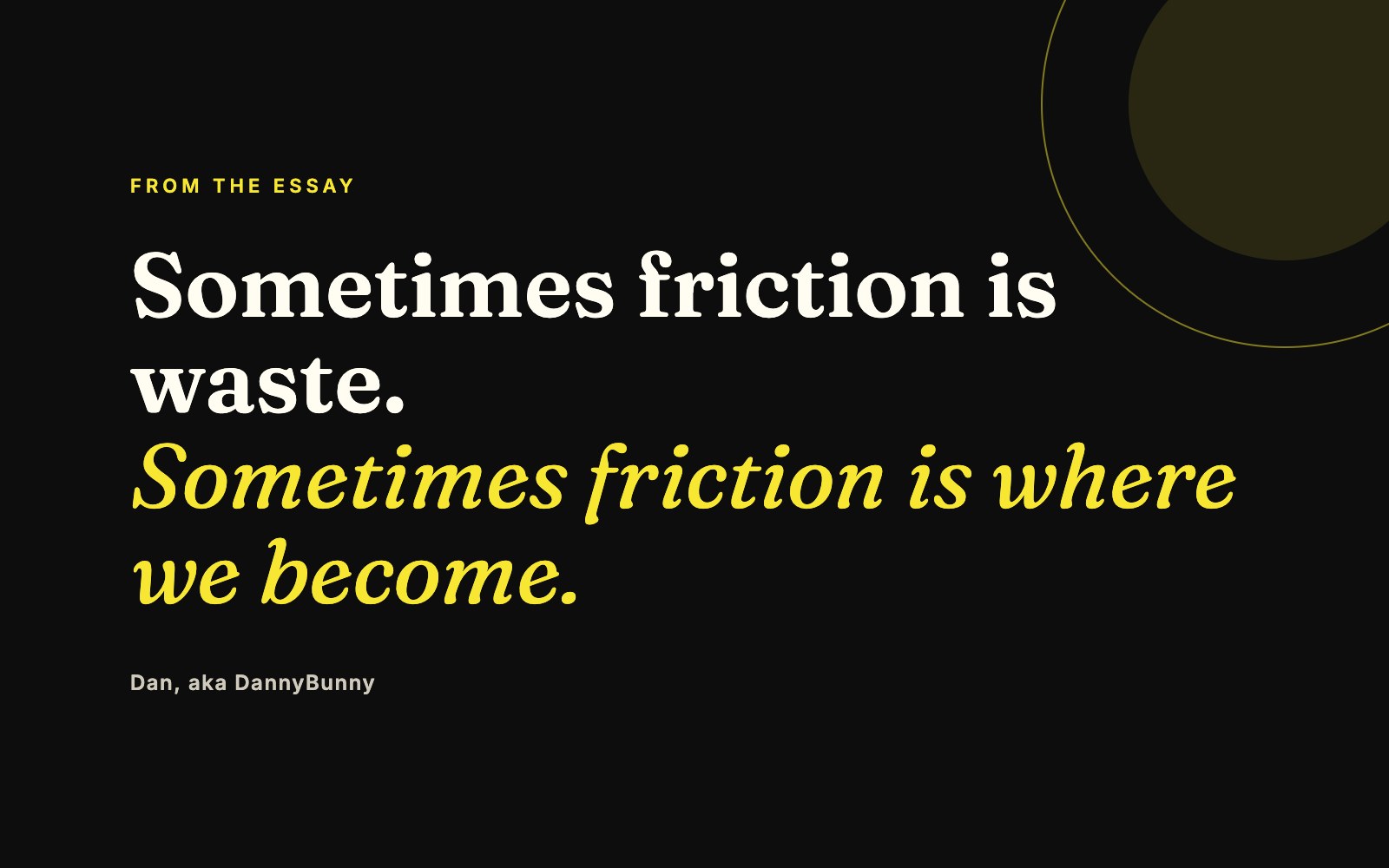
Sometimes friction is waste. Sometimes friction is where we become. Wisdom is knowing the difference.
I don’t believe our humanity is that fragile. Are we?
Perhaps this is where I feel most differently from some of the pessimism surrounding AI. I don’t believe access to generative technology means people will stop painting, playing instruments, writing, making things with their hands, telling stories, falling in love with ideas, arguing about books, cooking unnecessarily complicated dinners or spending years becoming extraordinarily good at something simply because they love doing it.
Human beings were creating long before anybody paid us for it. Creativity is our birthright (also a privilege, and joy, at the same time!). We create because something in us wants to make the invisible visible.
Technology changes the tools available to that impulse. It doesn’t automatically erase the impulse. And I refuse to think so little of human creativity that I believe the arrival of a powerful new technology inevitably means the end of it. If it’s joyful for us to create, why would we ever wanna stop???
The danger isn’t that AI will inevitably make us less human. The danger is that we might voluntarily surrender the very faculties that make us human because outsourcing them becomes convenient.
And my response to that possibility isn’t to abandon AI. It is to teach people what must never be outsourced. Namely our values, judgment, responsibility, relationships, lived experience, curiosity, taste, moral agency and care.
Those belong to us.
So where does that leave us?
AI is here. I don’t think our job is to worship it and I don’t think our job is to fear it either. I certainly don’t think our job is to hand our humanity over to it. It is our job to steward it.
That means learning what it can do and understanding where it fails. It means challenging the systems behind it and demanding better ones. It means using AI responsibly, teaching others to do the same and preserving the parts of being human that should never be optimised away.
Because AI doesn’t need to become human to expand what humans can do. And I don’t believe human creativity is so fragile that a new technology can simply steal it from us. I believe creativity is bigger than that. I believe we are bigger than that.
Perhaps the great opportunity of this moment isn’t merely discovering what artificial intelligence can become.
It’s deciding who we want to become alongside it.
xoxo,
Dan

Comments +